
Larger Down Payment vs. Safety and Liquidity
Most move-up buyers default to a big down payment because it feels safe. This case study shows why that instinct can leave real money on the table.
.png)
Larger Down Payment vs. Safety and Liquidity
The Scenario
A move-up buyer is selling their current home and rolling the proceeds into a new purchase. Like many move-up buyers, the client's instinct is to put a large amount down — in this case, 50% — because it keeps the monthly liability low.
That instinct makes sense from a cash flow standpoint. But it overlooks something most Americans' balance sheets already reflect: the majority of their wealth is concentrated in real estate, with little regard for diversification, safety, or liquidity.
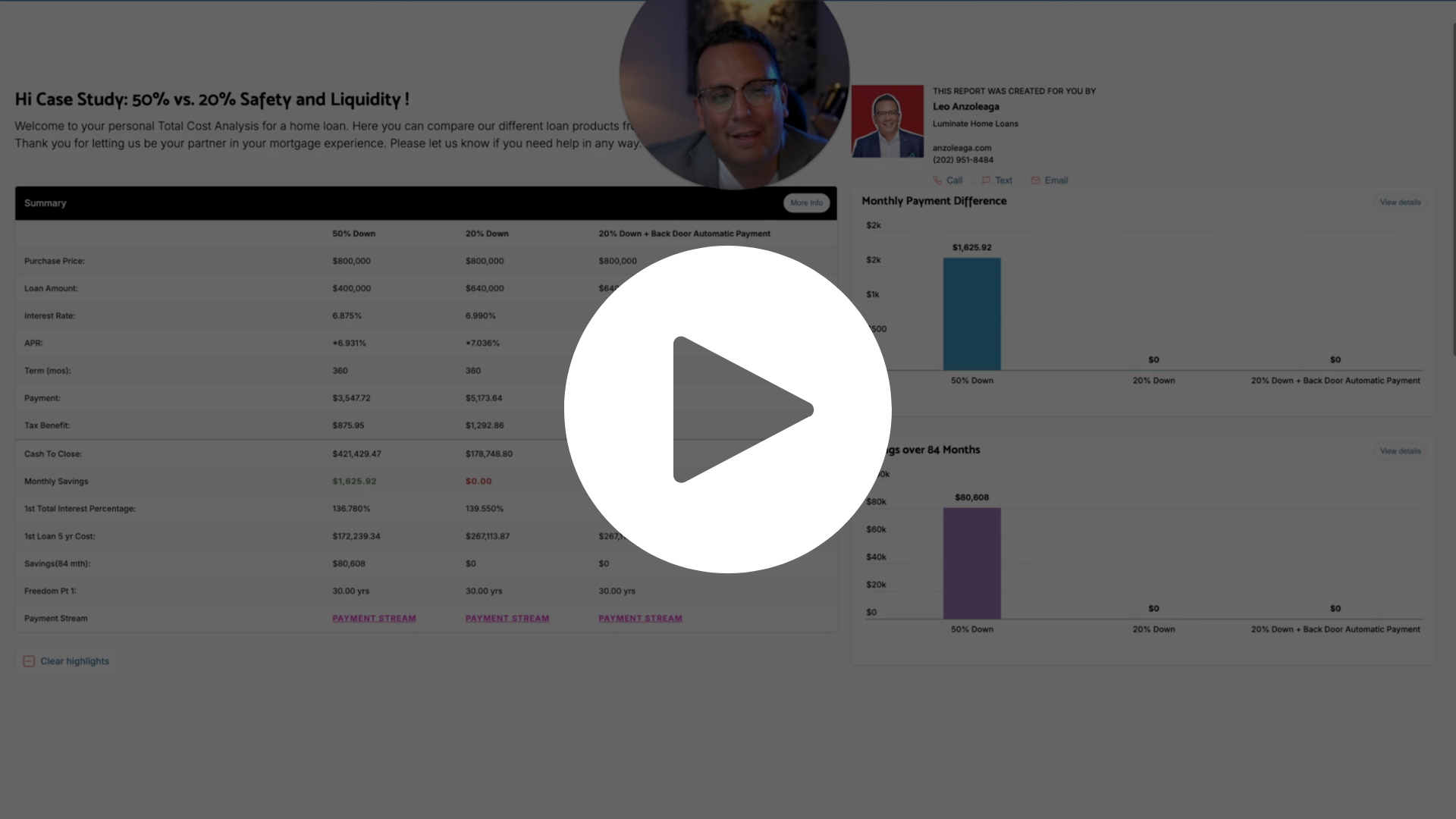
The Numbers: 50% Down
- Loan amount: $400,000
- Interest rate: 6.875%
- Monthly payment: $3,547.72
- Cash to close: $421,429.47
The Alternative: 20% Down
Putting 20% down instead of 50% raises the rate slightly (about an eighth of a point higher) and increases the monthly payment by roughly $1,600. But it also frees up approximately $242,000 in cash that would otherwise be locked into the home.
What Happens If That $242K Gets Invested
If that difference is invested rather than put toward the down payment, it compounds to $2.65 million over 30 years — money the client would have missed entirely by defaulting to the larger down payment.
A Middle Path: Subsidizing the Payment
Some clients are hesitant to take on a higher monthly payment, even for the sake of long-term growth. There's a third option: set up an automatic withdrawal of $1,625.92/month from the invested funds to subsidize the mortgage payment.
Even after covering that monthly subsidy, the invested $242,000 still grows by an additional $230,000 over 30 years compared to the 50%-down scenario — meaning the client keeps more money working for them while maintaining a comparable monthly payment.
Why This Matters
This is the liability side of the balance sheet doing real work. By modeling all three paths side-by-side, the client's advisor gains visibility into investable assets that would otherwise stay locked in home equity — and the client gets to see the tradeoff instead of just hearing about it.
[Watch the full case study here]
Have a move-up buyer weighing how much to put down? Send us the scenario, and we'll build a side-by-side comparison — including a reinvestment path — that you can walk through with them before they decide.
Increase your Mortgage Under Management
Join our program and begin enhancing the way you advise clients on their mortgages and more today.